
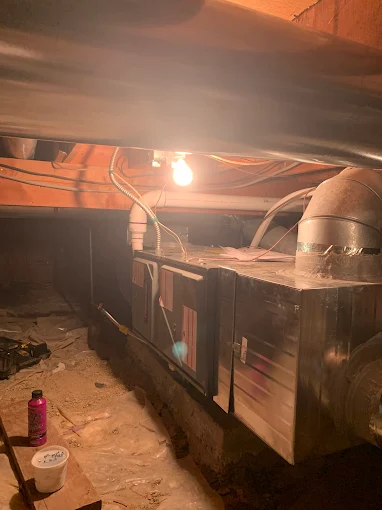
Almost nothing written about residential HVAC accounts for what life at altitude actually looks like — propane systems, snow loads, power outages, derated furnaces, frozen condensate lines, the works. This is the guide we wish someone had handed our foothill customers fifteen years ago. Save it, share it, refer back to it.
- 01 Why foothill heating is genuinely different
- 02 Interactive service area map
- 03 Heating fuel options compared
- 04 Altitude derating & sizing
- 05 Cold-climate heat pumps at altitude
- 06 Propane system deep-dive
- 07 Power outage resilience
- 08 Snow, wildlife & outdoor units
- 09 Indoor air quality at altitude
- 10 County & HOA considerations
- 11 Common foothill HVAC mistakes
- 12 Frequently asked questions
Foothill heating is harder than national HVAC articles let on. Altitude cuts your furnace output, propane is the dominant fuel above ~7,500 ft, power outages are routine, and most Front Range companies won’t drive up to fix any of it.
The right system for a Conifer cabin isn’t the right system for a Genesee modern build. Below: a real elevation-aware buyer’s guide, an interactive service area map, the math behind altitude derating, and the propane facts every foothill homeowner deserves to know.
When I started Right Way Mechanical out of Wheat Ridge, I’d take weekend hikes up Bergen Peak with friends. And every single weekend, without fail, somebody would corner me at the trailhead. “Hey — you do HVAC, right? Could you come look at our furnace? Nobody will drive up to look at it.”
The first time I thought they were exaggerating. They weren’t. Front Range companies will book a service call from Wheat Ridge to Boulder without thinking twice, but mention Bergen Park or Kittredge or Conifer and you’ll watch them suddenly check their boots and quote a “minimum trip charge” so high you know they’re hoping you say no.
So I started taking those calls. Then more of them. Then I got propane certified because half the foothill calls needed it. Then we built up a route system so the drive made sense for everyone. And eventually I realized what we were actually doing wasn’t HVAC work — it was being the company that shows up when the others won’t.
Fifteen years later, that’s still the line we won’t cross. If you live up the mountain, we’ll come up the mountain. No “is your driveway plowed” interrogation, no padded mileage fees, no upsell because we figure you’re stuck with us. Just honest work, done right, for the people who deserve it most — the ones nobody else will service.
Why foothill heating is genuinely different from anything you’ve read online
If you’ve Googled “best furnace for cold weather” or “how to size an HVAC system,” you’ve read articles written for sea-level homes in moderate climates. Those articles are not wrong — they’re just not relevant to you. Here’s what’s actually different about heating a home at 7,000 to 9,000 feet in the Colorado foothills:
The air is roughly 20–25% thinner than at sea level. That changes everything downstream. Combustion furnaces lose output. Propane appliances need different orifices. Heat exchangers run hotter for the same amount of fuel. Filters clog faster. Even your dog gets winded faster — your furnace does too.
The temperature swing is brutal. A January day in Evergreen can run from -10°F at 6am to +52°F at 2pm. That’s a 62-degree spread that hammers single-stage equipment with thousands of start/stop cycles that flatter homes never see. Two-stage and modulating systems aren’t just “nicer” in the foothills — they’re often the only thing that lasts.
The grid is unreliable in winter. Wind events, snow loading on lines, and tree falls mean foothill homeowners deal with multi-hour power outages every winter. Some neighborhoods average 8–15 outages a year. A heating system that requires constant power isn’t a complete system up here — it’s a partial one.
Fuel availability changes everything. Below about 7,500 feet you can usually get natural gas from Xcel. Above that, you’re on propane — your own tank, your own delivery schedule, your own combustion math. Switching between them isn’t trivial and isn’t a do-it-yourself project.
And nobody will drive up to fix any of it. The last one isn’t about HVAC physics — it’s about service availability. Three hours of round-trip windshield time on a service call is a real constraint, and most Front Range companies refuse it outright or price themselves out of it deliberately. That’s the real difference. The technical stuff is solvable. Finding someone who’ll actually show up is the harder problem.
Where we service — and what to know about each area
Tap any community below for elevation, typical fuel type, drive time from Wheat Ridge, and HVAC notes specific to that area.
The four real heating options in the Colorado foothills
National HVAC articles will list a dozen heating options. In practice, foothill homeowners are choosing between four: natural gas (where available), propane, electric/heat pump, and wood as supplemental heat. Here’s how they actually compare in our climate:
Natural Gas
Propane
Heat Pump
Wood Stove
Natural gas: the budget winner where you can get it
If your foothill home is below about 7,500 feet and on a natural gas line, you have the easy answer — natural gas furnaces or hybrid heat pump systems with gas backup. Operating cost is the lowest of any option, equipment selection is widest, and parts are universal. Genesee, lower Evergreen, Morrison, Idledale, and parts of Kittredge are typically natural gas territory. Conifer, Bailey, Pine, Buffalo Creek, and most homes above 7,500 ft are not.
Propane: what most foothill homes actually run on
Above 7,500 feet — and in many neighborhoods below that line, too — you’re on propane. That means a tank on your property (typically 500 or 1,000 gallons buried or above-ground), scheduled deliveries, and combustion equipment specifically configured for propane’s higher BTU density. The good news: a well-installed propane furnace runs every bit as cleanly and reliably as natural gas. The catch: propane costs 2–3× per BTU what natural gas does, and your supplier matters enormously — both for price and for the speed of winter refills. We’ll talk specifics in the propane deep-dive below.
Heat pumps: the underrated option (yes, even at altitude)
Cold-climate heat pumps have changed the math for foothill heating in the last five years. Modern variable-capacity models (Mitsubishi Hyper-Heat, Bosch IDS, Carrier Infinity Greenspeed) maintain efficient heating performance down to -13°F and operate, albeit less efficiently, well below that. For propane-dependent foothill homes, a heat pump as primary heat with propane or electric backup can cut annual heating costs by 30–50% — particularly with federal tax credits in play. More on this below.
Wood: the resilience play
A properly installed wood stove or insert is the only heating system that works during a multi-day power outage. It’s not a primary heat solution for most homes — labor-intensive, requires storage, requires chimney maintenance — but as a supplemental “keep the pipes from freezing when Xcel’s down for 18 hours” option, it’s genuinely irreplaceable. We don’t install them (find a wood stove specialist), but we strongly encourage foothill homeowners to have one if their primary system depends on grid power.
Altitude derating: the math nobody tells you about
Here’s the single biggest reason why a furnace that “should be fine” for your home size isn’t fine: combustion equipment loses BTU output as elevation increases. Air is thinner. Less oxygen reaches the burner. Less fuel can be burned cleanly. The standard industry rule of thumb is roughly 4% loss for every 1,000 feet of elevation above sea level.
That means a 100,000 BTU furnace tested at sea level is actually delivering:
How altitude affects furnace output
Real BTU delivery vs. the spec sheet number — at common Colorado elevations
So that “perfect” 100,000 BTU furnace recommended in a national article? In Conifer, it’s actually delivering closer to 66,000 BTU into your home. That’s not a small mismatch — it’s the difference between a system that handles a -10°F night with margin to spare and one that runs full-blast for 16 hours and never quite catches up.
Reputable installers compensate two ways. First, by oversizing the nameplate equipment to land at the right delivered BTU after derating. Second, by changing burner orifices to match altitude (this is required, not optional — using a sea-level orifice at 8,000 feet creates dangerous combustion conditions). Most factory propane conversion kits include altitude orifices for installation above 4,500 feet. If a contractor doesn’t mention orifice changes when bidding a foothill install, that’s a serious red flag.
Cold-climate heat pumps at altitude: the 2026 game-changer
If you last looked at heat pumps for your foothill home five or more years ago, the technology has fundamentally changed. The “heat pumps don’t work in cold weather” rule of thumb you may have heard is no longer true for modern cold-climate models. Here’s what’s actually happening:
Traditional heat pumps lost most of their efficiency below about 30°F and stopped working below 10–15°F. Modern cold-climate heat pumps — particularly variable-capacity inverter-driven models — maintain rated heating capacity down to about 5°F, deliver useful heat down to -13°F, and continue functioning (with reduced output) well below that. Mitsubishi’s Hyper-Heat units have been documented operating at -22°F.
For foothill homes, this opens a real strategic option: a cold-climate heat pump as primary heat, with propane or electric backup for the rare nights below -10°F. The math gets interesting:
- Propane operating cost for a 2,000 sq ft Conifer home: roughly $1,800–$2,800/year depending on use
- Cold-climate heat pump operating cost for the same home (with electric backup): roughly $900–$1,400/year
- Federal tax credit on qualifying heat pump installations: 30% up to $2,000
- Xcel Energy heat pump rebates (available in their service area): up to $1,800
The trade-offs are real. Heat pumps cost more upfront ($12,000–$22,000 installed vs $5,500–$9,000 for a propane furnace), need a backup heat source for true emergencies, and require power to operate (so a generator setup becomes nearly mandatory). The math works well for newer, well-insulated foothill homes. It works less well for drafty 1970s mountain cabins with single-pane windows. Get a real cold-climate load calculation done before committing either direction.
Propane systems: what every foothill homeowner should actually know
Most of what’s written about propane HVAC online is wrong, dated, or written by people who only work with natural gas. Here are the things that actually matter when you’re on propane in the foothills:
Tank size matters more than people realize. The standard residential propane tanks come in 250, 500, and 1,000 gallon sizes (above-ground or buried). For a typical 2,000–3,000 sq ft foothill home running propane heat, a 500-gallon tank fills roughly 80% (400 usable gallons) and lasts 4–8 weeks in deep winter. A 1,000-gallon tank lasts 8–16 weeks. The difference matters most when your propane company’s delivery schedule slips and you’re staring down a 4-day blizzard with 22% in the tank. Most foothill homeowners are better served by 1,000-gallon tanks than the 500s their builder installed.
Buried vs. above-ground is a real choice. Buried tanks look cleaner, last longer (no UV damage), and aren’t visible from the road — useful for some HOA situations. Above-ground tanks are cheaper to install ($800–$1,500 vs. $2,500–$4,500), easier to monitor, and easier to dig up if you ever decide to convert to natural gas. Neither is “better” — depends on your situation.
The orifice matters more than the burner. Natural gas and propane have different BTU densities, so the small brass orifice that meters fuel flow to the burner is different for each fuel. At altitude, the orifice gets smaller still. A propane furnace installed at 8,000 ft needs a specific orifice — not the sea-level propane orifice, not the natural gas orifice, not what was in the box. We see “professionally installed” propane furnaces every year where the original installer used the wrong orifice. The symptoms (yellow flame, sooting, poor efficiency) take months to surface but always do.
Your propane company isn’t the only one. Foothill homeowners often inherit a propane supplier when they buy the home, then stay loyal for years without checking. Local prices vary by $0.30–$0.60/gallon — on a 500-gallon delivery that’s $150–$300 per fill. Three quotes once a year is worth the 20 minutes it takes.
Generator + propane is the foothill power play. If you’re already paying for propane delivery, a propane-fueled standby generator runs off your existing tank, requires no separate fuel storage, and turns a 3-day power outage from a survival situation into a minor inconvenience. We don’t install generators, but if you’re considering one, the propane-fueled options are genuinely worth comparing against natural gas or diesel.
Power outage resilience: planning for when the grid quits
Some foothill neighborhoods see 8–15 power outages a year. That’s not a complaint about the utility — it’s a reality of running power lines through high-wind, snow-loaded mountain terrain. The question for every foothill homeowner is what happens when the power goes out at -8°F for 14 hours.
Here’s the order of failure during a winter outage:
The complete-resilience answer is a properly sized standby generator with automatic transfer switch. Mid-tier setup: a portable generator with manual transfer panel powering your furnace, fridge, and a few outlets. Bare-minimum setup: a properly installed and maintained wood stove. Knowing which level of resilience you actually need is part of designing a real foothill heating system — not an afterthought.
Snow loads, wildlife, and outdoor unit placement
If your foothill home has any outdoor HVAC equipment — heat pump, AC condenser, mini-split outdoor unit — placement matters more than at lower elevations. A few specifics we deal with constantly:
Snow stand height. At lower elevations, outdoor units sit 4–6 inches off the ground. In Conifer or Bailey, you want 18–24 inches minimum to clear typical snow accumulation, with consideration for drift patterns off the roof. We’ve pulled buried heat pumps out of 4-foot drifts in March. They don’t run well buried.
Roof avalanche zones. Snow sliding off a steep metal roof can crush an outdoor unit instantly. If your AC or heat pump sits within the fall line of a roof edge, it needs either relocation or a structural snow shed above it. We’ve seen $7,000 condensers totaled by a single Saturday afternoon’s snow slide.
Wildlife protection. Marmots, mice, and the occasional bear see warm equipment as cozy. Cabinets with hardware cloth screening keep critters out of the wiring. The damage from a single chewed control board run is more expensive than the screening would’ve cost to add at install.
Combustion air for indoor equipment. Tightly sealed mountain homes can starve furnaces of combustion air. Modern installations require a dedicated combustion air intake, sized correctly for the equipment and the home’s air tightness. This is often overlooked on remodels and DIY conversions.
Indoor air quality at altitude
Foothill homes have a unique set of indoor air challenges that aren’t well-covered in standard HVAC advice:
Bone-dry winter air. Indoor relative humidity in unmedicated foothill homes routinely runs 8–15% during deep winter — drier than the Sahara. That dries out sinuses, cracks wood floors, kills houseplants, and makes everyone feel colder than the thermostat says. A whole-home humidifier installed on the furnace plenum keeps indoor humidity at a sane 35–45% and is one of the single best comfort upgrades for any foothill home.
Wildfire smoke season. July through September now reliably brings days of degraded outdoor air quality across the Front Range and foothills. A properly designed system with high-MERV filtration (MERV 11 or 13, but only if your ductwork can handle the restriction) makes the indoors a genuine refuge during smoke events. Don’t just slap a MERV 16 filter into an old system — undersized ductwork chokes the system and can damage the blower motor.
Radon. Colorado has one of the highest residential radon problems in the country, and foothill homes built into hillsides are especially vulnerable. Radon isn’t an HVAC system but it interacts with HVAC ventilation. If you’ve never tested, do — test kits run $15 and may be the most valuable HVAC-adjacent purchase you’ll make.
County and HOA considerations
Our foothill service area crosses three counties, and they each handle permits, inspections, and code differently. Knowing which one you’re in matters before any HVAC work begins:
Foothill HOAs (especially in Evergreen, Genesee, and parts of Conifer) often have rules about outdoor unit visibility, propane tank screening, and architectural review for any visible equipment. We’ve worked through HOA approvals in most major foothill subdivisions — if your HOA has specific requirements, mention them up front and we’ll factor them into the proposal.
7 common foothill HVAC mistakes we keep getting called to fix
Most of the work we do up the mountain is correcting something that wasn’t done quite right by someone else. Not naming names — just patterns. These are the ones we see most often:
Contractor uses the orifice that came in the box without checking altitude. Yellow flame, sooting, poor efficiency. We’ve replaced systems where the fix was a $40 orifice and 20 minutes of combustion tuning.
Furnace nameplate says 100,000 BTU. At 8,000 ft it’s delivering 66,000. Home was sized for 90,000 BTU need. System runs nonstop in deep cold and never catches up.
Standard-efficiency heat pump installed as sole heat source. Works fine until the first -5°F snap. Cold-climate heat pumps with backup are a different conversation entirely.
Beautiful new heat pump under the corner of a steep metal roof. First March warm-up, snow slides off, crushes the unit. Owner finds out in May.
Modern tightly sealed mountain build, furnace installed without dedicated combustion air. Negative pressure starves the burner. Backdrafts CO into the home. Detector saves the day, hopefully.
500-gallon tank serving a 3,500 sq ft home with multiple propane appliances. Tank vapor pressure drops in deep cold, regulator can’t keep up, system locks out at 2am during the coldest night of the year.
Premium $18,000 heat pump system installed with no consideration for what happens during a 12-hour outage at -10°F. Pipes freeze. Big claim filed. Could’ve been a $2,500 generator and transfer panel.
Foothill home? Get a real, on-site quote from a team that services your zip code.
No “minimum trip charge” trap, no driveway interrogation, no upsell because we figure you’re stuck with us. Wheat Ridge to Bailey — we cover the whole map. Free written estimates. Propane and natural gas certified.
What to read next
If this guide has surfaced specific questions, these companion posts go deeper on each:
- Furnace Repair vs. Replacement: A Colorado Homeowner’s Honest Guide — the $5,000 Rule and decision framework
- How Much Does It Cost to Replace a Furnace in Colorado? — pricing transparency with an interactive cost calculator
- 7 Signs Your Furnace Is About to Fail — diagnostic guide with an interactive symptom checker
Frequently asked questions
Do you actually service Evergreen, Conifer, and Bailey?
Yes, every week. We have an established route system covering Wheat Ridge to Bailey via both the I-70 and US-285 corridors. No “minimum trip charge” surprise — drive time is built into our standard pricing. We service Evergreen, Conifer, Bailey, Pine, Buffalo Creek, Genesee, Morrison, Indian Hills, Idledale, Kittredge, Golden, and most surrounding communities.
Are you propane certified?
Yes. Our technicians are certified to install, service, and convert propane HVAC equipment. We carry altitude-rated orifices for propane systems on every foothill service truck. About 40% of our foothill work involves propane.
Will a regular furnace work at high altitude?
Only if it’s been correctly derated and the orifices are sized for altitude. A furnace sized for sea-level performance will deliver roughly 66% of its nameplate output at 8,000 feet, which usually means undersized heating. Manufacturers publish altitude derate factors and altitude-specific orifices — your installer must apply both.
Are cold-climate heat pumps a good fit for foothill homes?
Often yes, especially for newer well-insulated foothill homes currently running expensive propane heat. Modern variable-capacity cold-climate heat pumps maintain capacity to about 5°F and operate down to -13°F or lower. They work best paired with propane or electric backup heat for the rare deep-cold nights. Federal tax credits and Xcel rebates can reduce installation cost by $2,000–$4,000+ on qualifying systems.
How much does a foothill HVAC installation cost vs. a Denver one?
Typically $500–$1,500 more, depending on access, fuel type, and elevation. The cost increase reflects drive time, altitude orifice changes, sometimes additional venting work, and (for propane homes) gas line modifications. We provide written, itemized estimates so you can see exactly where the costs come from.
What size propane tank do I need for heating?
For most 2,000–3,000 sq ft foothill homes running propane as primary heat, a 1,000-gallon tank is the right choice. 500-gallon tanks work but require more frequent fills and risk running low during multi-week cold spells. If you also have propane water heater, range, dryer, or fireplace, lean toward 1,000 gallons regardless.
Do you handle propane-to-natural-gas conversions?
Yes, if Xcel’s gas line reaches your property. The conversion involves changing burner orifices, regulator settings, and combustion tuning, plus coordinating with the gas utility for the new service. We’ve done dozens of these in lower-elevation foothill neighborhoods where natural gas service has been extended.
What should I do during a winter power outage in the foothills?
If you have a generator, run it. If not, conserve heat aggressively: close interior doors to unused rooms, hang blankets over large windows, drip indoor faucets to prevent pipe freezing, and gather in one central room. If indoor temperatures drop below 50°F, consider relocating until power returns. Never use propane patio heaters, generators, or grills indoors — every winter, foothill homes lose people to CO from improvised indoor heat.
How fast can you respond to a no-heat emergency in Conifer or Bailey?
Same day in most cases, including evenings and weekends, weather and road conditions permitting. We dispatch from Wheat Ridge and typical response time to the Conifer/Bailey corridor is 2–4 hours from your call. During major storm events, we prioritize calls by safety risk — homes with vulnerable occupants or imminent pipe-freezing risk get first response.
Do you work with my foothill HOA?
Yes. We’ve completed installations in most major foothill HOA communities, including Genesee, Hiwan, Soda Creek, Bear Mountain, and many others. We’re familiar with common architectural review requirements around outdoor unit screening, propane tank visibility, and venting routing. Mention your HOA up front and we’ll factor any specific requirements into the proposal.
Need foothill HVAC done by people who actually live this stuff?
Family-owned. Wheat Ridge based. Propane and natural gas certified. Serving the entire I-70 and US-285 corridor from Golden to Bailey. 24/7 emergency service. Free written estimates. We show up.